
AUTHOR’S NOTE: This page owes a great deal of gratitude to my friend, Julie B. whose invaluable contributions made up a significant 80% of this instructional page.

There are no recommended route orders provided by the developers. However, If you want a “soft” recommended route order for convenience, my suggestion would be:
Suzu → Soshiro → Mitsuki → Fumi → Kai → Neji → Kisa
WALKTHROUGHS:






♦♦STAT RAISER♦♦
- For the stat-raising aspect, the key solution is to primarily focus on the stat associated with each character. It’s colour coded for your convenience. For example, Mitsuki’s stat is “VOICE”, represented by light blue, while Fumi’s stat is “AGILITY”, represented by the color, crimson red.
- There are no right or wrong ways to max a specific character’s stat. However, it’s important to reach a stat level of 30/30 (or somewhere between 20-30) before December 25th (Christmas Day) in order to smoothly progress into a character’s individual route.
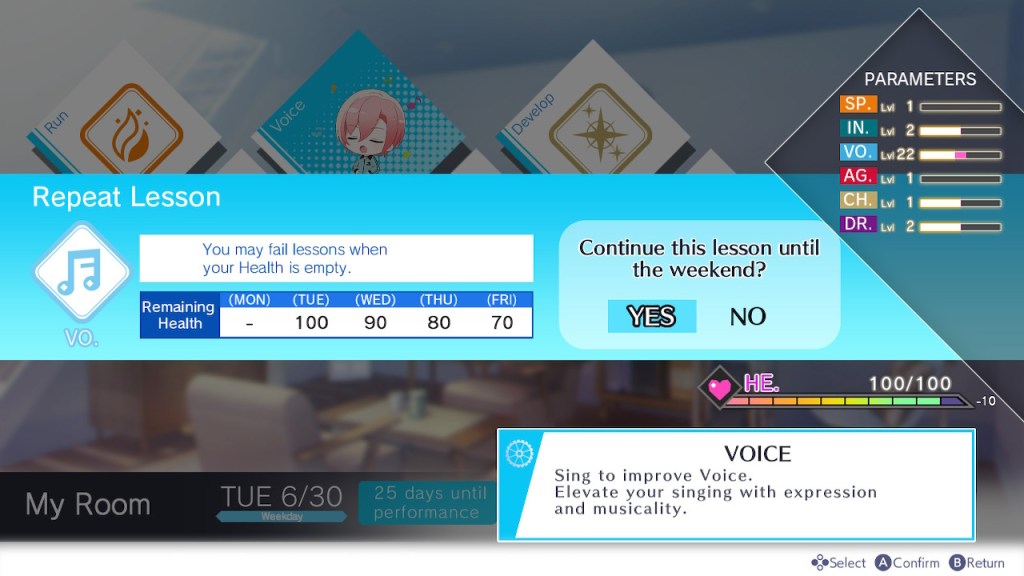
- When you’re on the screen to select a lesson (a.k.a “My Room”), simply press ‘R’ to repeat that lesson for the entire week or the remaining days of the week. Just keep in mind to REST if your health bar is almost depleted. If you take lessons while your health bar is empty, there is a high chance that the lessons will fail, and there won’t be any stat increase for that day. The guides I’ve prepared will indicate the days on which you should rest to regain your health/stamina points every other week.
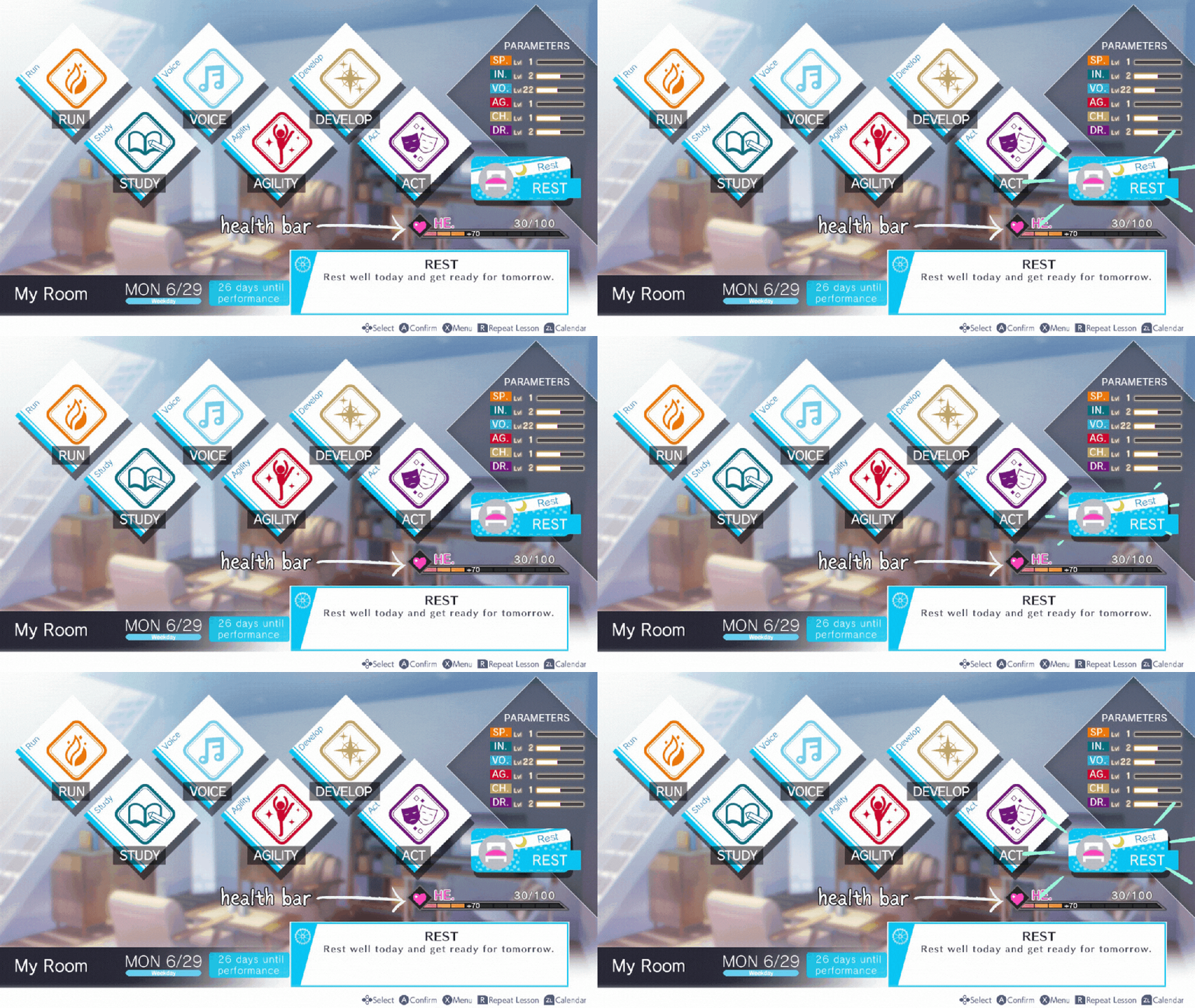
- During the weekends, it is recommended to ‘Go Out’ and spend these days with the character you’re aiming for. By doing so, you will gain additional points on their stat meter.
- After the “Newcomer’s Performance” (the first play), Mona Star School will unlock for the weekends. You can select Mona Star School, if you’ve got nothing you want to pick for weekend activities, This is also a good option for increasing stats. Keep in mind that selecting Mona Star School on weekends is optional.

- There will be specific set dates where Quartz professor, Enishi (CV: Umehara) tells you what approximate placement Kisa should get for the individual awards depending on your stats.
- The dates are: April 28th, June 30th, September 22nd, November 23rd, and the final play changes depending on the route you’re in.
- If you don’t receive a Gold Prediction prior to the Winter Performance, I recommend starting over from an earlier save point. Not obtaining a Gold in the Winter Play affects your getting a gold ranking for the final play (Univeil Performance), which is detrimental to achieving the character’s Best and Good Endings. If you’re following my walkthroughs, you shouldn’t have to worry about this.😘
- During the Summer Break, which spans from July 27 to August 31, you not only have the option to “Go Out” on weekends but also on Tuesdays and Thursdays. While you can visit different locations and meet different people around Univeil, it is recommended to spend as much time with your chosen LI as frequently as possible to earn more points in their parameters. In addition, the points you get from doing lessons are also doubled during this time.
- There’s a cute little calendar (that you can view by pressing ZL) that lays out your monthly schedule in the “My Room” section.

♦♦RHYTHM GAME♦♦
- The game is very good at indicating when the rhythm game practice is. If you’re feeling unsure about it, I suggest creating a hard save on a separate file during your first playthrough.
- Newcomer’s Performance practice: May 4th (Song), May 7th (Dance)
Summer Performance practice: June 10th (Dance), June 26th (Song), June 29th (Dance)
Fall Performance practice: Sept 2nd (Song), Sept 18th (Dance), October 5th (Dance)
Winter Performance practice: Nov 4 (Song), Nov 12 (Dance), Nov 30 (Song)
Univeil Performance practice: CHANGES BY ROUTE.- Suzu: Jan 7,13
- Kai: Jan 8,12
- Fumi: Jan 13,19
- Neji: Jan 27,29
- Mitsuki: Jan 11, Feb 1
- Soshiro: Jan 11, 20
- Kisa: Jan 8, 20
- Newcomer’s Performance practice: May 4th (Song), May 7th (Dance)
- Practice is mandatory in the first playthrough; after that, you are free to skip it whenever you like.
- All songs EXCEPT FOR THE LAST TWO (Quartz Anima and Over the Wall) will have practice segment for them.
- Once you finish a playthrough, the rhythm game sections unlock in the gallery, allowing you to practice and try other difficulties without any consequences. With subsequent playthroughs, you can unlock the “Jack Jeanne” difficulty, which can only be played in the gallery.
- Although the game does not care which difficulty level you use for the songs, to secure first place in the class awards, you will need to achieve an SS rank on at least one of the songs during a Performance/Play.
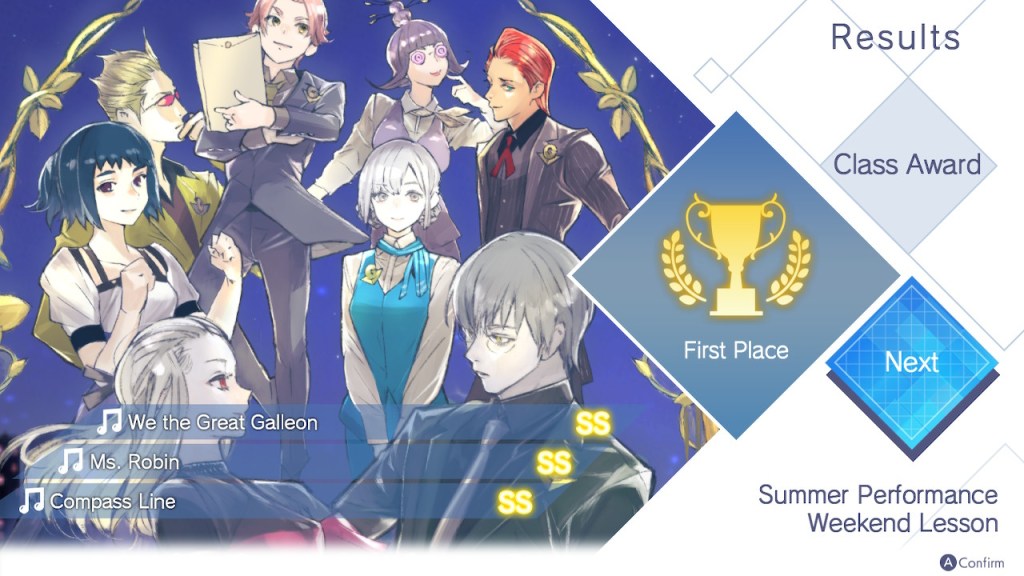

- The ‘NORMAL’ and ‘HARD’ mode on the rhythm games are beginner-friendly. ‘EXPERT’ mode is where you want to be if you want some sort of challenge in your rhythm games.
- The skill you receive during rhythm games is typically determined by the LI with the highest affection.

- List of Skills:
- Suzu and Kai: Doubles your points (lasts for 7 seconds)
- Soshiro and Neji: Changes “GOOD” to “PERFECT” (lasts for 8 seconds)
- Mitsuki and Fumi: Changes “MISSED” to “GOOD” (3x)
- You have the option to play the rhythm game using your Switch’s touchscreen (both for the ‘sing’ & ‘dance’ part).
- You have the option to change the controls of the Rhythm Game by accessing “Rhythm Actions” in the Options tab, or you can leave it as it is – whichever is comfortable for you!
♦EVENT BASED COMMON ROUTE & TIPS♦
- Since the game is event-based, the development of the heroine’s and the LI’s relationship primarily occurs through the progression of the events in the common route (before entering a specific route, respectively). To unlock a character’s route, you must view all of their pre-route “affection” event scenes, which are unlocked based on their stat meter and your progress in the common story. These scenes often include CGs.
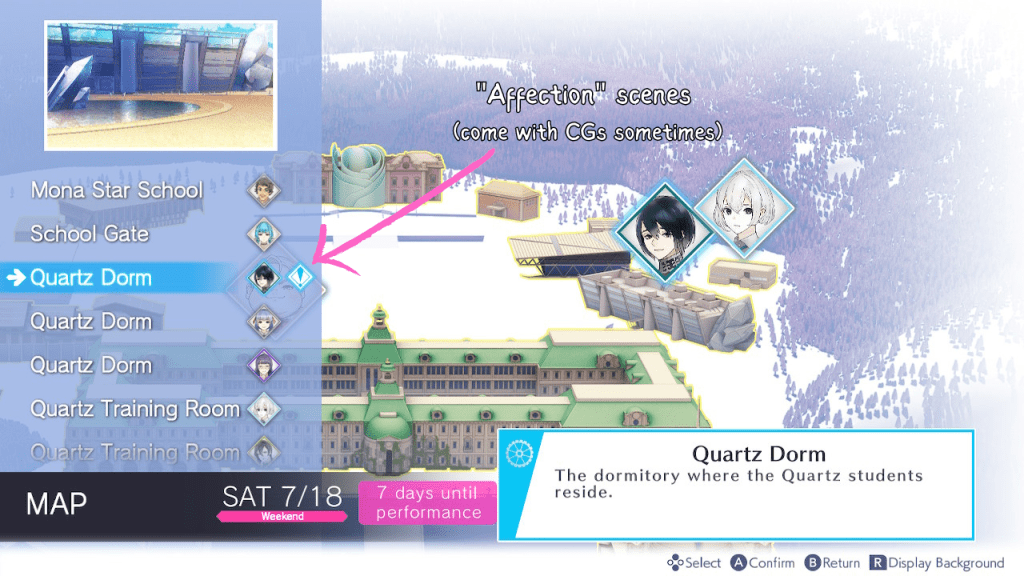
- The mini-weekend scenes, where you choose a character to spend time with, contribute to increasing the affection level and ultimately help unlock the CG scenes. It is highly recommended to select the character you are interested in as frequently as possible whenever they come up. Not only do these interactions add cute and often hilarious moments, they also provide deeper insights into the LI’s personalities and their relationship with Kisa.
- The game is 80% common route. The route proper starts on Christmas Day –immediately after the Winter Performance. If you hit all the requirements, you should have the choice to spend Christmas with a character (typically the LI with the highest points in the stat meter).
- Take breathers between routes as the game is quite LONG.

♦♦♦FUN FACTS♦♦♦
- The game’s setting draws heavily from Takarazuka, including its school and the extravagant and dramatic stage productions associated with it. Even some of the terminology used in the game is inspired by Takarazuka.
- The Newcomer’s Performance in Jack Jeanne (first play), is based off of the same newcomer performance concept in Takarazuka where the newcomers perform the lead roles.
- Jack and Jeanne are basically otokoyaku and musumeyaku. Al Jeanne and Jack Ace are based off of the top star rankings and golden combination. The class categories in the game can be seen as reminiscent of the different troupes in Takarazuka. For example, one could associate elements of the Moon troupe with Rhodonite in the game.




♦FAQs♦
Disclaimer: Most of our answers border from facts to opinions. We will however, lay our thoughts out as transparent as possible!🙇♀️
“Is this an Otome Game?”
JB: Short answer: Yes. Even Ishida calls it “ORE NO OTOME GAME”. Even things like having a non-romance route is pretty common in otome games (e.g. Angelique, Piofiore, Steam Prison)
OK: (nods in agreement)
“But they didn’t advertise it as an Otome”
JB: Short answer: None of them are really advertised as such. Even Idea Factory doesn’t call their Otomate games “otome” in their official advertising. Otome is more of an unofficial categorization.
OK: In the Nintendo Eshop (both in JP and West), none of the otome titles are actually advertised as “Otome” in the genre section. Instead, they are mostly categorized as ‘Adventure’ or ‘Adventure Game’.
JB: In fact, the ‘Adventure’ genre is probably the more accurate term for “visual novels” and a lot of other games that may not fall under certain traditionally known ones like RPG or Action.
“Does this game have romance? What’s the ‘romance level’ like in Jack Jeanne?”
OK: (chuckles) Here we go…😅
JB: It’s subjective! Because of certain factors such as the length of the character route, the amount of sugar and/or spice content, and how the plot does not revolve around the relationship, most would call it “light on romance”. One of the routes that people consider to be barely romantic, I thought was incredibly romantic. So it’s really a matter of one’s personal definition of what’s “romantic”.
Granted, I’m also very biased because most games that people consider “light on romance” or “plot focused” are typically super romantic for me.
OK: While I personally think that some routes do become really romantic, overall, I would say that the game has a modest romantic aspect. The romance is definitely present, no doubt, but it is not the sole focus of the story.
“Can I play this even though I’m not good with stat raisers or rhythm games?
JB: There’s not a lot to worry about! The game tries to be accessible with both stat raising and the rhythm game portion. Truthfully, the stat raising portion is super easy once you understand its flow and there’s options to help you with the rhythm games.
OK: You can practically SS a song in ‘Normal’ mode with your eyes closed!😝 (lol jk)
 Otome Kitten